



 By
By 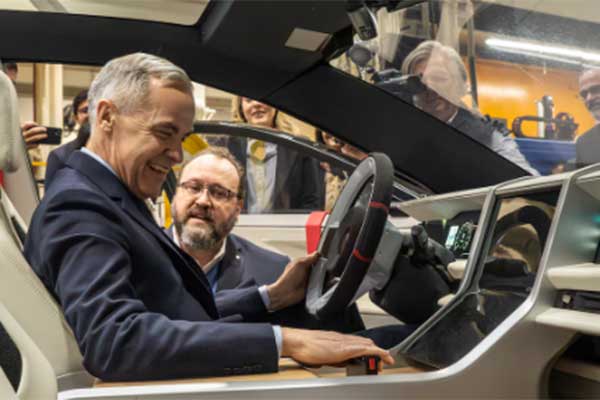
- Ottawa canceled the 2035 EV sales mandate and will introduce emissions-based rules that allow multiple vehicle technologies.
- The new strategy restores a $5,000 EV purchase incentive and commits billions to charging infrastructure and domestic auto manufacturing.
- Trade tensions with the United States and lagging EV uptake are reshaping Canada’s approach to electrification.
Canada has formally stepped back from its most ambitious electric vehicle sales mandate, scrapping a rule that would have required all new vehicles sold by 2035 to be electric.
The shift, announced by Prime Minister Mark Carney, marks a recalibration of federal climate policy at a moment when the country’s auto industry is facing intensifying trade friction with the United States and uneven global momentum for EV adoption.
What’s happening
Carney’s government has canceled the federally imposed EV sales targets that were introduced under Justin Trudeau, which required automakers to reach 20% electric sales by 2026, 60% by 2030, and 100% by 2035. In their place, Ottawa plans to introduce new regulations by year-end focused on overall fleet emissions rather than specific technologies.
The revised strategy sets aspirational targets of 75% EV sales by 2035 and 90% by 2040, paired with renewed incentives. These include a $5,000 federal rebate for EV buyers, scaled down over time, funding for nationwide charging infrastructure, and billions in tax credits and industrial support aimed at keeping auto manufacturing in Canada.
Carney framed the move as a pivot toward “results and solutions,” arguing that rigid mandates failed to reflect market realities, infrastructure gaps, and the growing disruption caused by U.S. trade policy.
Automakers have faced new tariffs on Canadian-built vehicles with non-U.S. components, a challenge Ottawa says violates the USMCA.
Why it matters
The stakes are high.
Canada’s auto sector supports roughly 500,000 jobs and remains deeply integrated with U.S. supply chains, with parts crossing the border multiple times during production. That model is under strain as Washington pushes for domestic-only vehicle manufacturing.
At the same time, EV adoption has lagged political ambition. Electric and plug-in hybrid vehicles account for roughly 10% of new Canadian car sales, well below earlier mandate thresholds. Industry groups, including Global Automakers of Canada, welcomed the rollback as overdue clarity, while the Canadian Climate Institute cautiously endorsed the shift as a pragmatic path to lower emissions.
Globally, Canada is not alone.
The U.S. has rolled back EV tax credits, and the European Union has softened its own 2035 combustion-engine ban, underscoring the political and economic headwinds facing electrification.
What comes next
Ottawa plans consultations on a new emissions-based framework and a tradable credit system that would reward vehicles manufactured in Canada.
The government is also betting on domestic critical minerals and battery supply chains to anchor future growth.
The broader message is one of realism over symbolism. Canada’s EV transition is no longer being driven by mandates alone, but by incentives, trade strategy, and industrial policy. Whether that slower, more flexible approach delivers both climate gains and economic security will define the next decade of the country’s auto sector.











Comments