



 By
By 
- Canada needs to more than triple its renewable capacity, adding up to 88 GW by the mid-2030s to meet rising electricity demand.
- Global capital is available, but investors are prioritizing jurisdictions with predictable permitting, interconnection and construction timelines.
- Execution bottlenecks—not economics or technology—pose the biggest risk to Canada capturing its full clean energy opportunity.
Canada is emerging as a leading destination for global clean energy investment, with as much as $200 billion expected to flow into wind, solar and energy storage over the next decade.
The case is compelling: strong natural resources, stable institutions and rising electricity demand driven by electrification, population growth and industrial expansion. But for investors, the question is shifting from potential to performance—whether Canada can build projects quickly enough to compete for mobile global capital.
A new report from the Canadian Renewable Energy Association outlines the scale of the challenge.
Canada currently operates about 25 gigawatts of renewable capacity, but will need to add between 54 and 88 gigawatts by the mid-2030s. That would more than triple the system in under a decade, requiring annual investment of up to $20 billion.
Capital Is Not the Constraint
The global backdrop is favorable. Clean energy investment now exceeds $3 trillion annually, and capital is actively seeking jurisdictions with stable returns.
Recent U.S. policy shifts have redirected some of that capital toward markets like Canada. Yet investor priorities have evolved. Delivery timelines, how quickly projects move from approval to operation, now carry as much weight as economics or resource quality.
This is where Canada’s position becomes less certain. Renewable projects are increasingly slowed by complex permitting processes, growing interconnection queues and transmission constraints. The report is clear: the limiting factor is not financing or technology, but the time required to deliver projects.
Competing on Execution, Not Scale
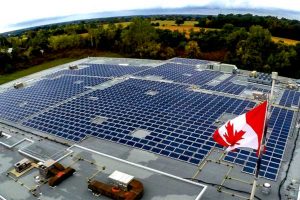
Rooftop Solar Panel Installation of 422 kW for Great Circle Solar in Ontario, Canada (AGT)
Canada is not competing with global peers on volume, but on reliability.
In 2025, China added more than 430 gigawatts of renewable capacity, while India added roughly 44 gigawatts. Canada’s additions were a fraction of that.
Investors do not expect comparable scale, but they do expect predictability.
Increasingly, capital is flowing toward jurisdictions that can convert commitments into operating assets without prolonged delays.
The urgency is amplified by structural demand growth.
Electrified transportation, data centres and industrial reshoring are driving up electricity consumption after decades of stagnation. If supply lags, the impact extends beyond energy markets, affecting the viability of investments in manufacturing, mining and infrastructure.
The Investment Case, With Conditions
Canada’s fundamentals remain strong. Roughly 24 gigawatts of renewable capacity is already in development or procurement, reflecting sustained investor interest. But the transition from procurement to construction remains uneven, with projects often delayed by grid access and regulatory bottlenecks.
For investors, the opportunity is real but conditional. Canada offers long-term stability and growing demand, but execution risk is now central to the investment thesis.
If permitting, transmission and policy alignment improve, the country could capture a significant share of global clean energy capital.
If not, that capital will continue to move toward markets where timelines—and returns—are more certain.











Comments