



 By
By - Perovskite–organic tandem solar cells were engineered to suppress deep trap states and reverse tunneling, yielding high reverse-bias stability.
- Organic subcells reached irreversible breakdown voltages below −35 V, while tandems retained >90% efficiency at −40 V and 97% after 2,000 h at −4.5 V.
- Power conversion efficiency exceeded 26%, indicating durable, shade-resistant thin-film photovoltaics.
It is common for solar panels to be shaded by trees, clouds, birds or buildings.
For thin-film solar technologies, however, such shading can cause shaded areas to develop reverse-bias stress (negative voltage), which can reduce power-generation efficiency and even damage solar cell modules.
A research team at The Hong Kong Polytechnic University (PolyU) has developed a new generation of perovskite–organic tandem solar cells (POTSCs) that not only deliver high power-generation efficiency but also effectively resist damage caused by negative voltage. Even under an extreme reverse bias of -40 V, the tandem devices retain more than 90% of their initial power-generation efficiency, far surpassing all existing thin-film solar technologies—marking a key step toward the practical application of thin-film solar technology.
Thin-film solar technologies, such as cadmium telluride (CdTe), copper indium gallium selenide (CIGS), perovskite and organic solar cells, offer distinct advantages, including lightweight, flexibility and cost-effective manufacturing.
However, these materials share a common weakness: Because of their electron-ion hybrid conducting properties, once a solar cell is partially shaded and generates negative voltage, maintaining sustained performance becomes difficult and components may even be damaged. The ability to resist reverse bias is therefore key to determining whether thin-film solar technology is durable and capable of stable, long-term operation.
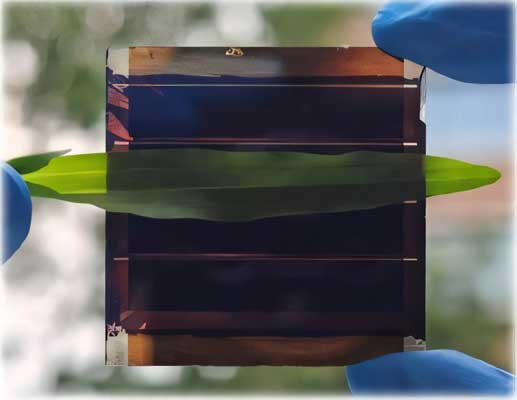
Photograph of the POTSC minimodule. (Nature Materials 2026)
A weak point under shading
Organic solar cells (OSCs) have made significant strides in efficiency and durability in recent years. Yet their behavior under reverse-bias conditions and the underlying charge transport mechanisms in bulk heterojunctions (the power-generating active layer inside the cell, formed by blending two materials) remain largely unexplored.
Filling these knowledge gaps is an indispensable step toward the practical application of thin-film solar technology.
Professor Li Gang, chair professor of energy conversion technology in the PolyU Department of Electrical and Electronic Engineering, Sir Sze-yuen Chung Professor of Renewable Energy and associate director of the PolyU Research Institute for Smart Energy (RISE), and his research team have tackled the often-overlooked yet critical aspect of reverse bias.
Li said, “We have achieved important advances in the stability of OSCs and POTSCs under challenging reverse-bias conditions. Our research makes breakthrough contributions to the understanding of both device operation and durability in organic and perovskite solar technologies.”
Defects behind reverse-bias damage
The reason OSCs are damaged under reverse bias lies in defects known as deep trap states within the bulk heterojunction. These invisible traps in the solar cell material immobilize the charges responsible for power generation, reducing the cell’s efficiency and even causing damage.
The team achieved a breakthrough through innovative approaches and strategic interventions. By suppressing isolated acceptor clusters within the donor-acceptor intermix region (the area at the power-generating core of the cell where the two materials responsible for releasing and receiving charges are blended), the team minimized the above-mentioned defects and developed high-performance OSCs with an irreversible breakdown voltage exceeding -35 V.
In other words, as long as the negative voltage does not exceed -35 V, the cell will not be permanently damaged. This substantially enhances damage resistance and establishes a new benchmark for the efficiency and stability of OSCs.
Protecting the perovskite layer
The study shows that, by suppressing reverse tunneling (the phenomenon whereby, when a solar cell is shaded, current flows in reverse, generating negative voltage and damaging the cell) in n-i-p inorganic perovskite-organic tandem solar cells, the organic solar cells successfully protect the perovskite layer. Even after exposure to an extreme reverse bias of -40 V, the tandem devices retained more than 90% of their initial efficiency.
Moreover, these tandem solar cells proved highly stable: After continuous operation at -20 V for 12 hours, they retained 90% of their initial efficiency, and after continuous operation at -4.5 V for 2,000 hours, they retained as much as 97% of their initial efficiency—far surpassing all existing thin-film solar technologies.
The research has been published in the paper “Perovskite–organic tandem solar cells with superior reverse-bias stability,” in Nature Materials.
The study provides a comprehensive understanding of reverse charge transport mechanisms in bulk-heterojunction organic solar cells, overcomes reverse-bias instability in perovskite-based solar cells and provides critical guidelines for developing robust POTSCs.
Progress toward practical modules
In earlier research, Li and his team demonstrated that n–i–p inorganic POTSCs achieved an impressive power conversion efficiency (PCE) of 25.9% (certified at 25.1%) through bottom-contact modulation, with improved stability under various conditions. That study was published in Nature Energy in 2025.
In the latest study, the n-i-p POTSCs also demonstrated a PCE exceeding 26%, along with unparalleled reverse-bias stability, advancing their progress toward practical applications. Dr. Huang Jiaming, postdoctoral research fellow, and Han Yu, Ph.D. student, both of the PolyU Department of Electrical and Electronic Engineering, are the first authors of the Nature Materials and Nature Energy articles, respectively. Dr. Ren Zhiwei, research assistant professor in the same department, is the co-corresponding author of both publications.
Li added, “The exceptional reverse-bias stability under shading conditions has been vividly demonstrated in scalable perovskite-organic tandem solar cell minimodules. This marks a significant leap forward, paving the way for a sustainable and efficient future powered by renewable energy systems.”
Publication Referenced in the Article:
Jiaming Huang et al, Perovskite–organic tandem solar cells with superior reverse-bias stability, Nature Materials (2026). DOI: 10.1038/s41563-026-02541-6
This article has been adapted from source material published by Hong Kong Polytechnic University.





Comments