


 By
- An automated platform combined rapid imaging, environmental measurements and machine learning to link perovskite film formation with film quality.
- Millisecond tracking of antisolvent droplets guided coating optimization, yielding a lead-based perovskite solar cell with 24.4% power conversion efficiency.
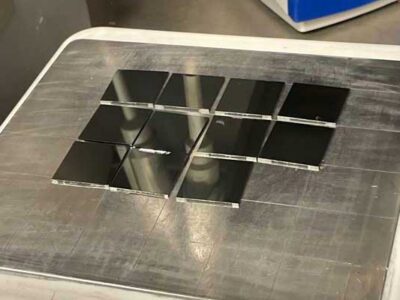
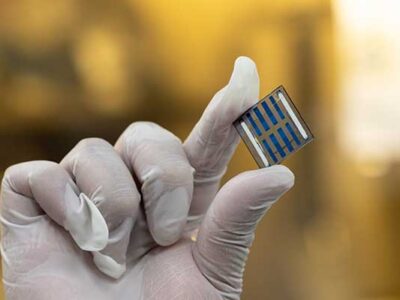
Solar cells generate electricity by absorbing sunlight in a thin layer of perovskite, a light-absorbing material.
This layer is made with a liquid solution that dries and crystallizes into a solid film, but small changes in temperature, humidity and other conditions can affect the film and the performance of the solar cell.
Now, recent research combining a robot system with machine learning may overcome this challenge.
Researchers from the University of Osaka have published their findings on a newly developed automated platform for fabricating perovskite films. The system coordinates film deposition with optical imaging and environmental measurements. The findings were published in ACS Nano.
The team used the platform to investigate the transformation of the liquid coating to a crystalline film, focusing on changes in film color and the behavior of antisolvent droplets. As these changes can occur rapidly, the researchers needed measurements that could capture the process on very short timescales. The resulting observations provided detailed information about how events during film formation influence the final material.
“We want to move beyond trial and error by measuring what happens to the film while it is actually forming,” says lead author Ryosuke Kado. “Our system allows us to connect these real-time changes with the quality of the perovskite film and identify the factors that matter most.”
Tracking droplets within milliseconds
The system can capture changes in film color on a subsecond timescale and resolve the motion and impact of antisolvent droplets within just a few milliseconds. By capturing these rapid events, the platform enabled the researchers to examine how the timing and behavior of the droplets influence subsequent film formation.
“The advantage of automation is that we can collect much richer information than would be practical by hand,” says senior author Akinori Saeki. “Machine learning helps us make sense of these many variables and identify relationships that are difficult to see.”
Droplet control improves solar-cell efficiency
The researchers also applied these insights to refine the antisolvent coating process. The analysis identified an optimal range for droplet behavior, which the researchers used to guide the fabrication of a lead-based perovskite solar-cell device.
Under the optimized conditions, the device reached a power conversion efficiency of 24.4%, demonstrating that information gathered during film formation could be used to improve an actual solar cell.
By enabling researchers to observe and analyze film formation as it happens, the platform offers a more systematic approach to optimizing solar-cell fabrication. The combination of automated experimentation, real-time measurements and data analysis could help uncover previously unknown relationships between processing conditions and film quality. The team is optimistic that this technology will catalyze photovoltaic research and enable more practical solar cells.
Publication Referenced in the Article:
Ryosuke Kado et al., Automated Perovskite Film Fabrication with High-Resolution Data Acquisition and Machine Learning Analysis, ACS Nano (2026). DOI: 10.1021/acsnano.6c11386
This article has been adapted from source material published by the University of Osaka.





Comments