


 By
- Ontario is introducing major reforms to its 58 electricity distributors as the province confronts an estimated $103 billion to $120 billion in infrastructure investment needs over the next two decades.
- The changes focus on governance, financial accountability and long-term planning.
- But they also raise an important question for the solar industry: Could distributed solar and battery storage help utilities manage rising electricity demand while reducing the need for some costly grid expansions?
Ontario is preparing significant reforms to its electricity distribution sector, responding to mounting concerns that aging infrastructure and insufficient investment could undermine the province’s ability to meet rapidly growing electricity demand.
Energy and Mines Minister Stephen Lecce announced the proposed changes on October 27, introducing new financial oversight, governance requirements and long-term infrastructure planning for the province’s 58 local distribution companies (LDCs).
The reforms follow recommendations from the Panel for Utility Leadership and Service Excellence (PULSE), which warned that many utilities are increasingly unprepared for the scale and pace of Ontario’s electricity transition.
A $120-billion infrastructure problem

Ontario’s Independent Electricity System Operator (IESO) control room; from where the province’s electricity market and system are managed in real-time. The IESO directs the flow of electricity over electrical grid lines, while transmission companies own, operate and maintain the lines and towers. (IESO)
Ontario’s electricity distributors could require between $103 billion and $120 billion in infrastructure upgrades over the next two decades, according to the Electricity Distributors Association.
Meanwhile, the Independent Electricity System Operator (IESO) projects provincial electricity demand could increase by approximately 75% by 2050.
Electric vehicles, industrial electrification, population growth and expanding manufacturing operations are expected to drive much of that increase.
For local utilities, the challenge extends beyond maintaining existing infrastructure.
Distribution networks must accommodate new electricity connections, changing consumption patterns and increasingly complex power flows as more customers adopt technologies such as rooftop solar and battery storage.
New requirements could reshape utility investment
Under the proposed reforms, electricity distributors would be required to develop 10-year infrastructure and financial plans addressing asset conditions, investment requirements and workforce needs.
New financial assessments would also examine whether utilities can distribute profits to shareholders without compromising necessary infrastructure investments.
The government is additionally proposing independent, skills-based boards, limiting municipal representation to one non-voting member.
These changes are intended to strengthen financial accountability and encourage long-term infrastructure investment.
PULSE also identified utility consolidation and greater access to institutional capital as potential solutions for smaller distributors struggling to finance network upgrades.
The reforms come as Ontario pursues new electricity generation and storage capacity through its LT2 procurement program, adding urgency to questions about how the province’s distribution networks will accommodate future supply.
Where solar and battery storage fit

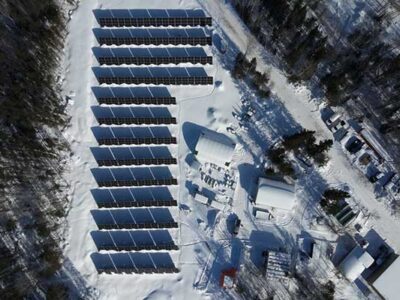
Stephen Lecce, Ontario’s Minister of Energy and Electrification, says the Tilbury Battery Storage Project — once built — will store 80 megawatts of power equivalent to powering 80,000 homes. (Dale Molnar via CBC News)
Although the reforms primarily address utility governance and financing, they could have broader implications for Ontario’s distributed energy market.
Traditionally, utilities have responded to growing electricity demand by expanding substations, transformers and distribution lines.
But distributed energy resources offer additional options.
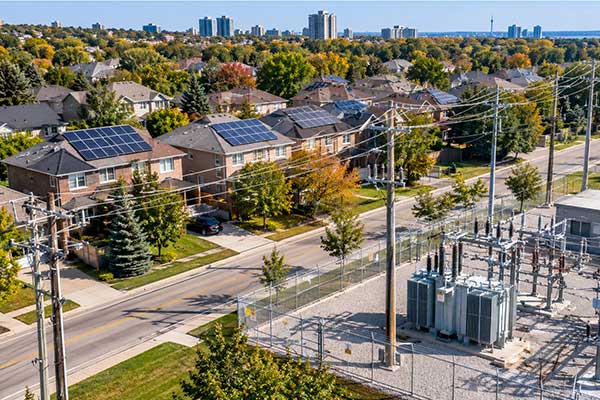
Rooftop and community solar installations can generate electricity closer to where it is consumed, while battery storage can help manage peak demand, improve flexibility and potentially defer certain infrastructure upgrades.
These technologies cannot eliminate the need for conventional grid investment. Their value depends on local network conditions, system design and appropriate compensation mechanisms.
However, incorporating them into long-term distribution planning could help utilities evaluate alternatives to expensive infrastructure expansions.
Perspective: Ontario needs a smarter grid, not simply a bigger one
Ontario’s proposed reforms acknowledge an increasingly important reality: electricity distribution is becoming central to the province’s economic and energy ambitions.
But strengthening utility balance sheets represents only part of the solution.
The larger opportunity is to modernize how electricity networks are planned, financed and operated.
For Ontario’s solar and storage industries, the question is whether utilities will increasingly recognize distributed energy resources as infrastructure solutions rather than simply additional connections to manage.
That distinction could determine how effectively the province balances grid reliability, affordability and its growing electricity needs.










Comments