


 By
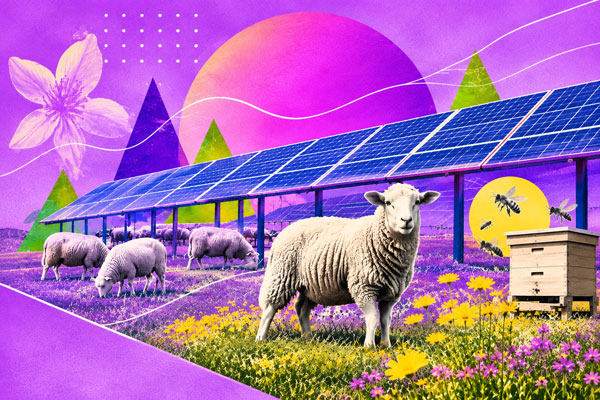
- An Alberta solar farm is demonstrating how renewable electricity and agriculture can coexist.
- The 75-megawatt Sollair project combines nearly 190,000 solar panels with sheep grazing, hay production and beekeeping, generating enough electricity for approximately 23,000 homes.
- But declining solar approvals and changing provincial regulations are raising concerns about whether similar projects can be developed in Alberta.
On a 480-acre property north of Airdrie, Alta., sheep graze between solar panels, tractors harvest hay and roughly two million bees produce honey.
It’s an unusual combination, but one that Mark Owerko and his business partners spent eight years bringing to life, according to the Calgary Herald.
Their Sollair Energy Project has nearly 190,000 solar panels generating enough electricity to power approximately 23,000 homes. Meanwhile, the land continues supporting agricultural activities, the Calgary Herald reported.
Owerko, managing partner at General Land and Power Corp., says the project is demonstrating an approach to combining agriculture and solar generation at a scale that had no established model for developers to follow.
But nearly two years after the 75-megawatt facility began operating, he questions whether another project like it could be built under Alberta’s current regulations.
Can solar farms and agriculture coexist?
The approach, known as agrivoltaics, combines solar electricity generation with agricultural activities on the same land.
Rather than removing farmland entirely from production, developers design solar installations to accommodate livestock, crops or other agricultural uses.
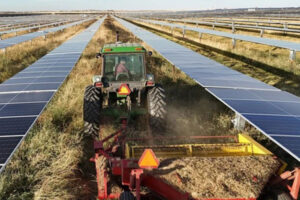
The Sollair Energy Project, a 75-megawatt solar array north of Airdrie, has a surprising twist. (CalgaryHerald)
Sheep help control vegetation around the panels, potentially reducing mowing costs at Sollair. Hay production continues, while more than a dozen beehives support honey production and pollination.
Beekeeper Cimberly Kneller, who manages approximately two million bees on the property, says the insects provide agricultural benefits by helping pollinate crops and potentially improving yields.
Research suggests agrivoltaics can offer environmental benefits beyond producing clean electricity.
A 2019 University of Arizona study published in Nature Sustainability found that partial shade from solar panels improved growing conditions for certain crops in hot, dry environments while reducing water loss.
However, benefits vary depending on climate, crop selection and panel configuration. Not every agricultural activity is compatible with conventional solar installations.
Owerko hopes to eventually introduce higher-value crops at Sollair, which currently produces hay.
Why Alberta’s solar industry is slowing down
Despite Sollair’s success, renewable energy advocates say Alberta’s regulatory changes are discouraging similar investments.
The province accounted for 92 per cent of Canada’s renewable energy capacity growth in 2023. That year, Alberta introduced a seven-month pause on new wind and solar approvals, followed by restrictions affecting agricultural land and scenic landscapes.
Heather MacKenzie, executive director of Solar Alberta, believes the current regulatory environment makes another development comparable to Sollair extremely unlikely.
She says developers are increasingly choosing to invest in jurisdictions with more favourable conditions rather than pursuing projects in Alberta.
Alberta Utilities Commission figures show solar approvals declining from 24 projects in 2024 to 12 in 2025 and six so far in 2026.
The provincial government disputes suggestions that renewable investment has stalled, arguing that Alberta has attracted substantial renewable development in recent years.
The office of Affordability and Utilities Minister RJ Sigurdson attributes the current slowdown to an electricity surplus and changing market demand rather than regulatory barriers.
Additional costs are also emerging. Since October, Alberta has imposed a $14 recycling fee on each new solar panel to support end-of-life waste management.
For a project Sollair’s size, that would add approximately $2.66 million in upfront costs.
Could investment move elsewhere?
Jorden Dye, director of the Business Renewables Centre of Canada, warns that developers have opportunities elsewhere as British Columbia, Quebec, Ontario and Manitoba expand electricity procurement.
He says Alberta projects completed after the 2023 pause had largely secured approvals and investment commitments before the restrictions took effect.
Dye believes renewable energy development is accelerating elsewhere in Canada while Alberta experiences a significant slowdown, potentially putting future investment at risk.
For farmers and policymakers, Sollair demonstrates that renewable electricity generation and agricultural production need not be competing land uses.
Whether Alberta’s regulatory environment will allow more projects to follow that example remains uncertain.
Owerko says he would consider developing another project like Sollair if the conditions made it possible.




Comments