



 By
By 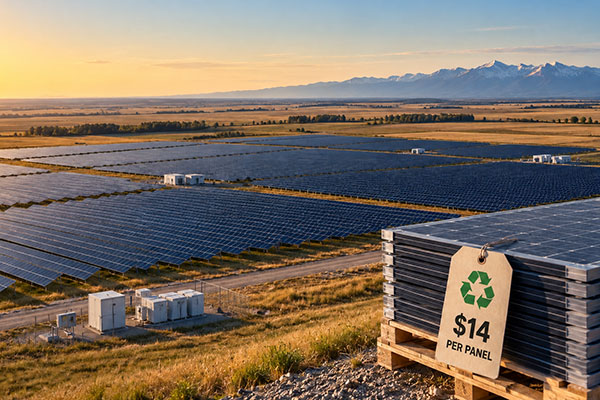
- Alberta’s new recycling fee takes effect October 1.
- BRC-Canada estimates the fee could add roughly $1 million to the upfront cost of an average utility-scale solar project.
- The fee follows reclamation rules that BRC-Canada found were more costly than those in the 27 jurisdictions it reviewed.
Alberta is introducing a $14 recycling fee on solar panels beginning Oct. 1, prompting criticism from a renewable energy industry group that says the charge is significantly higher than comparable fees elsewhere.
The fee is intended to support the end-of-life management and recycling of solar equipment in the province.
Business Renewables Centre-Canada (BRC-Canada) says it supports establishing recycling programs for solar equipment but argues Alberta has not provided sufficient analysis to justify the size of the new charge.
According to BRC-Canada, its comparison of recycling programs found Alberta’s $14 fee to be between 139% and 3,500% higher than charges in the jurisdictions it examined.
The organization estimates the fee could add approximately $1 million in upfront costs to an average utility-scale solar project in Alberta, depending on the number of panels installed.
“We’re disappointed to see the government saddle the industry with another disproportionate burden,” said Jorden Dye, director of BRC-Canada.
“While BRC supports the introduction of a recycling fee, we cannot support a punitive tax far exceeding any other jurisdiction.”
Recycling fee follows new reclamation requirements
The recycling charge follows earlier changes to Alberta’s renewable energy reclamation requirements.
In a June 2025 analysis, BRC-Canada compared Alberta’s reclamation security system with rules identified in 27 jurisdictions across North America, Australia and Europe. The organization concluded that Alberta’s requirements resulted in the most costly reclamation security system among the jurisdictions it examined.
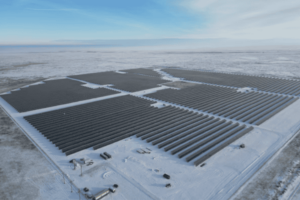
The Tilley Solar project consists of 70,000 photovoltaic panels. At its peak, the site will generate 280 full-time jobs and $20-million in labour income. (Tilley Solar Alberta/Supplied via The Globe And Mail)
Alberta requires renewable energy developers to provide security covering reclamation and decommissioning activities, regulatory assessments needed to obtain a reclamation certificate, and one year of crop or grazing losses associated with reclamation.
For portions of a project where security is not provided through a surface lease with the landowner, developers must provide 30% of estimated reclamation costs upfront, followed by 60% of the most recent estimated costs on the 15th anniversary of operations.
BRC-Canada’s analysis found that no other jurisdiction it reviewed had an upfront security requirement as high as Alberta’s 30%. Jurisdictions with similarly structured formulas required no more than 10% upfront.
The report also identified salvage value as a significant difference between Alberta and other jurisdictions.
About 75% of jurisdictions using predefined formulas for calculating security deduct the expected salvage value of equipment from gross decommissioning costs. Alberta does not, meaning its security requirement is calculated against the gross reclamation estimate.
“This is the same story we saw with renewable energy reclamation costs: Alberta setting a price without accounting for salvage value or learning from comparative jurisdictions,” Dye said.
“BRC-Canada supports recycling programs and land reclamation as part of a strong, responsible renewable energy sector in this province. However, this approach adds costs and red tape to an industry that has helped diversify Alberta’s economy and lower electricity prices for Albertans.”
Most solar panels won’t retire for decades
BRC-Canada is also questioning the timing and calculation of the recycling charge.
Much of Alberta’s utility-scale and rooftop solar fleet has been installed within the past decade. With solar panels generally expected to operate for decades, much of that equipment will not reach end of life until well into the 2040s.
The organization says the Alberta Recycling Management Authority has not published a detailed breakdown explaining how the $14-per-panel figure was calculated.
The added cost arrives as Alberta’s renewable energy sector faces a markedly different investment environment from the rapid expansion that made the province Canada’s leading market for new wind and solar development in recent years.
BRC-Canada argues that accumulating regulatory costs, including reclamation security and recycling requirements, risk making future Alberta projects less competitive.
Billions invested through renewable energy agreements
BRC-Canada says approximately 3.73 GW of renewable electricity was purchased through power purchase agreements across Canada between January 2019 and March 31, 2025, with much of that activity concentrated in Alberta.
Those agreements enabled approximately 4.77 GW of project capacity and an estimated 14,700 GWh of annual electricity generation.
According to the organization, the resulting development supported approximately 7,000 jobs and $7.5 billion in capital investment, while producing enough electricity to power about 1.9 million homes.
Wind and solar projects operating in Alberta municipalities also generated approximately $70 million in municipal tax revenue in 2025, BRC-Canada said.
The debate over the recycling fee is therefore likely to extend beyond waste management. For developers, the question is increasingly whether the cumulative cost of Alberta’s renewable energy rules is changing the economics of building new projects in a province that, until recently, attracted the bulk of Canada’s corporate renewable energy investment.










Comments