


 By
By 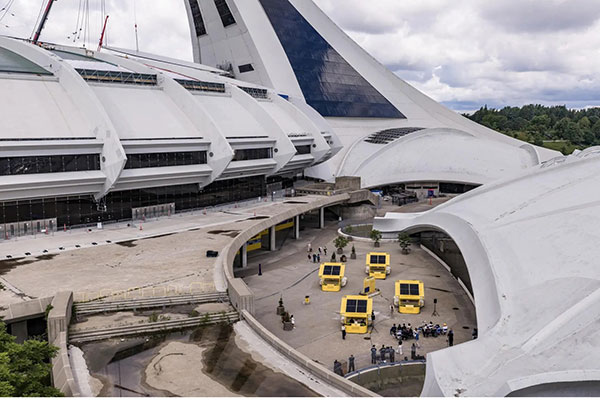
- Espace solaire is billed as the province’s first outdoor public space powered entirely by solar energy.
- The project combines on-site solar generation, energy storage and intelligent power management with Wi-Fi, outlets and outdoor workspaces.
- The installation arrives as Hydro-Québec plans for 3,000 MW of solar capacity by 2035, giving solar a larger role in Quebec’s electricity mix.
Montreal’s Olympic Park has added a permanent unusual piece of infrastructure, that operates entirely on solar power, to its sprawling public space.
Developed by urban design firm Aire commune in collaboration with Sunbird Énergie, Espace solaire is billed as the first outdoor public square in Quebec powered entirely by solar energy. Located at the base of the Olympic Tower behind the Biodôme, the free space combines solar generation and energy storage with amenities including high-speed Wi-Fi, electrical outlets, shaded seating and outdoor work areas.
Unlike rooftop solar installations that largely disappear into a building, the photovoltaic system is incorporated directly into the site’s architecture, making energy production a visible part of the public space.
The project was originally expected to open in 2025, but was delayed after Aire commune received components that did not meet specifications. Its opening was subsequently pushed to 2026.
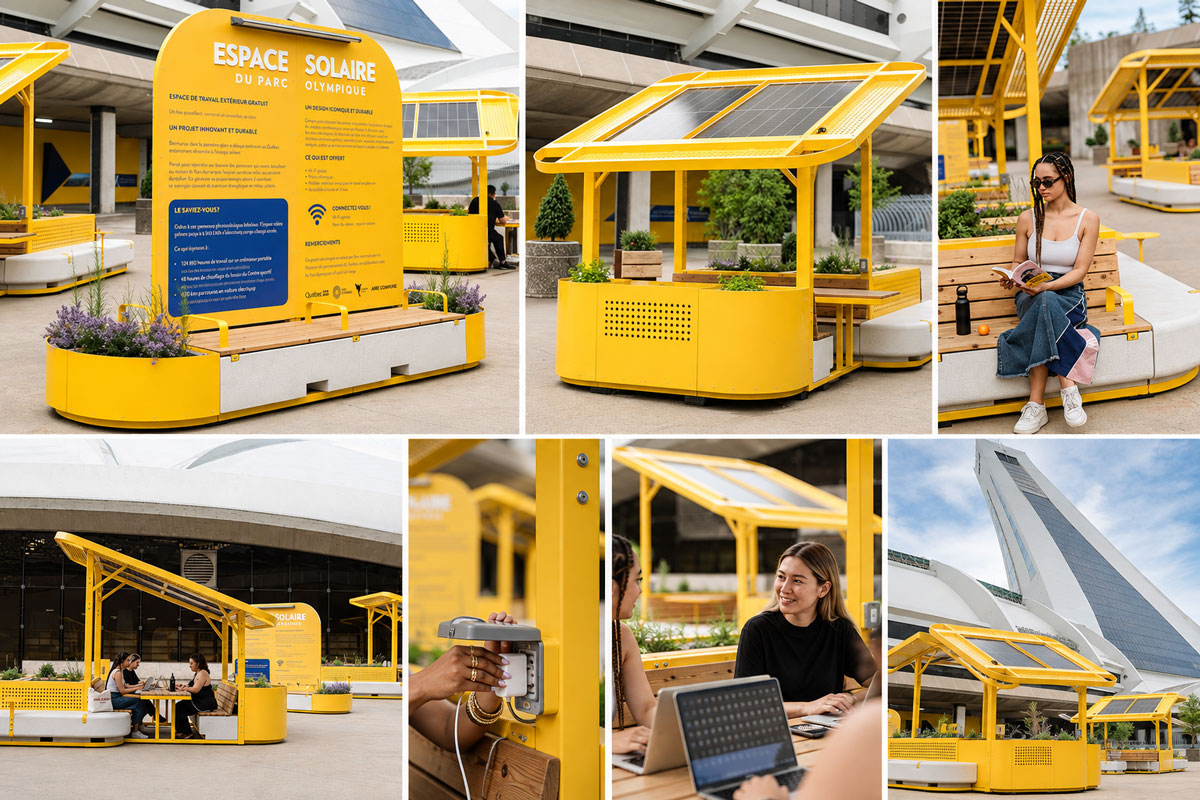
Espace solaire is billed as the first outdoor public square in Quebec powered entirely by solar energy.
Part of a larger east Montreal investment
Espace solaire is backed by $800,000 from the Quebec government and forms part of a broader $23-million initiative aimed at revitalizing Montreal’s east end.
The location is significant. Olympic Park says the surrounding Olympic district receives roughly one million visitors annually and employs about 2,000 people, while the project is also intended to serve residents of Mercier–Hochelaga-Maisonneuve.
For Aire commune, the installation builds on its Îlots d’été network of outdoor workspaces. The organization says that initiative has attracted more than 300,000 visitors and generated over $3.5 million in economic activity since 2021.
Solar takes a larger role in Quebec
The project arrives as Quebec begins giving solar energy a more prominent role in a power system historically dominated by hydroelectricity.
Hydro-Québec now aims to develop 3,000 MW of solar capacity by 2035, arguing that solar can complement hydro and wind while being deployed relatively quickly. Its first major procurement includes 300 MW of solar projects targeted for connection by 2029.
That expansion comes as electricity demand is expected to rise sharply through electrification and decarbonization. Hydro-Québec estimates the province could require an additional 150 to 200 TWh of electricity annually by 2050, approaching a doubling of today’s system requirements.
Perspective
Espace solaire is small compared with the generation projects Quebec will need over the coming decade, but its significance may be less about how much electricity it produces than where that electricity is produced.
By integrating generation, battery storage and energy management directly into everyday public infrastructure, the project demonstrates a more distributed model for solar. Parks, transit facilities, parking areas and other urban spaces can potentially become both consumers and producers of electricity.
For a province where solar has long occupied a marginal position beside abundant hydroelectricity, Espace solaire offers a visible example of how that relationship is beginning to change.




Comments