



 By
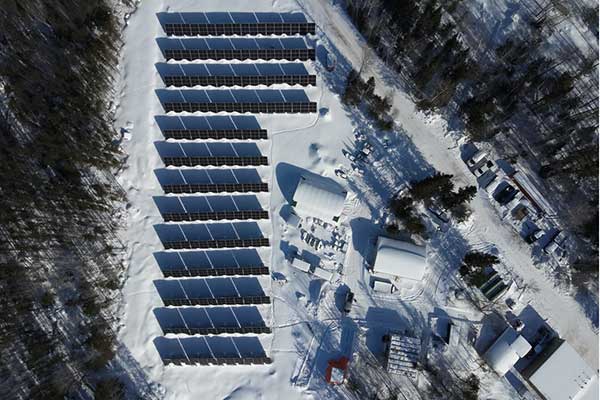
- An award-winning microgrid at Ontario's IISD Experimental Lakes Area is designed to replace up to 80% of the facility's diesel-generated electricity.
- The $2-million-plus project combines 297 kW of solar capacity with battery storage and existing diesel generators.
- In an exclusive PVBUZZ interview, Operations Manager Roger Mollot discusses the project's early performance, estimated 12–15-year payback and the financial barriers preventing similar systems from becoming more widespread across Canada.
For nearly six decades, scientists at a remote research station in northwestern Ontario have studied how human activity affects freshwater ecosystems. Yet the electricity powering their laboratories, accommodations and research equipment came almost entirely from diesel generators.
That contradiction is now being addressed through an ambitious solar-plus-storage microgrid.
The IISD Experimental Lakes Area (ELA) MicroGrid Project, developed with Charge Solar and KPE Electrical Contractors, recently received the 2026 Canadian On-Site (BTM) Project of the Year Award from the Canadian Renewable Energy Association (CanREA) during Electricity Transformation Canada 2026 in Toronto.
The system is designed to replace up to 80% of the facility’s diesel-generated electricity, potentially eliminating approximately 80,000 litres of diesel consumption and more than 200 tonnes of carbon emissions annually.
For Canada’s remote communities and industrial facilities, the implications extend well beyond one research station.
$2-million-plus investment
The project combines 540 solar panels rated at 550 watts each, delivering 297 kilowatts of DC capacity, with a 250-kilowatt inverter and battery energy storage system.
During daylight hours, solar generation powers the facility while charging batteries. As sunlight declines, stored energy takes over. Diesel generators automatically restart when battery reserves reach a predetermined threshold.
The facility accommodates up to 55 researchers and operates laboratories, workshops, dormitories and a commercial kitchen.
Its electricity demand fluctuates between approximately 30–40 kilowatts during winter and 60–70 kilowatts during peak summer operations.
The project cost more than $2 million, financed through Environment and Climate Change Canada funding and private philanthropic contributions.
Initial engineering estimates projected a 15-year investment payback, potentially improving to approximately 12 years under favourable operating conditions.
What the project tells us
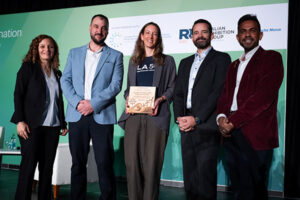
Representatives of IISD Experimental Lakes Area and Charge Solar receive the 2026 Canadian On-Site (BTM) Project of the Year Award at Electricity Transformation Canada in Toronto. (Photo: CanREA)
Following the award announcement, I sat down with Roger Mollot, Operations Manager at IISD Experimental Lakes Area, to discuss the project’s performance, economics and broader implications.
PVBUZZ: Is the system delivering the anticipated 80% reduction in diesel-generated electricity?
Mollot: The project remains in commissioning, but early performance is encouraging. During summer, diesel generators operated approximately four hours daily, with solar and battery storage supporting the facility for the remaining 20 hours.
He believes these results suggest the system is approaching its intended performance target.
However, a complete assessment will require additional operational data, particularly through winter.
PVBUZZ: How does the system maintain reliability during northern Ontario’s harsh winters?
Mollot: The facility’s powerhouse incorporates multiple layers of redundancy. If batteries encounter technical problems or generators fail, backup systems automatically respond.
The coming winter will provide the first comprehensive assessment of the microgrid’s performance through December, January and February.
PVBUZZ: What’s preventing similar projects from becoming more widespread across Canada?
Mollot: “There really is no technological excuse for why we cannot be moving our remote communities towards a renewable energy future.”
He argues that solar, storage and remote monitoring technologies are sufficiently developed. The larger obstacles are financial and political.
Public investment, private financing and partnerships between communities and industry will be essential to expanding deployment.
Why this project matters
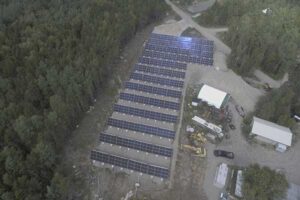
The IISD Experimental Lakes Area microgrid in northwestern Ontario combines a 297 kW solar array with battery storage and existing diesel generators. (Photo by IISD-ELA)
What interests me most about this project isn’t necessarily its size or even the award.
It’s what the project reveals about the economics of energy transition in remote Canada.
A facility that once depended entirely on diesel can now operate for substantial portions of the day using solar generation and stored electricity.
But the distinction between technical feasibility and commercial scalability matters.
A project requiring more than $2 million in upfront investment and an estimated 12–15-year payback will not automatically be accessible to every remote community.
Its performance also remains under evaluation, particularly during winter when solar production declines.
Still, the project demonstrates something important: reducing diesel dependence no longer requires waiting for an entirely new technological breakthrough.
The equipment exists. The engineering expertise exists. And increasingly, the operational experience exists.
The more difficult question for Canada is how to make these investments financially accessible to the communities and facilities that need them most.
That’s where the next chapter of Canada’s remote energy transition will be written.









Comments