
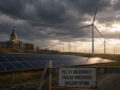


NEW YORK — Global renewable power capacity reached 5.15 terawatts (TW) at the end of 2025 following a record year of deployment, but significantly faster growth will be required to meet the global target of tripling renewable capacity by 2030.
A record 693 gigawatts (GW) of renewable capacity was added in 2025. To reach the 11.2 TW target established under the UAE Consensus at COP28, annual additions will need to average approximately 1,200 GW between 2026 and 2030.
The findings are outlined in Delivering on the UAE Consensus: Tracking Progress Toward Tripling Renewable Energy Capacity and Doubling Energy Efficiency by 2030, released by the International Renewable Energy Agency (IRENA), the COP31 Presidency Türkiye and the Global Renewables Alliance (GRA) during Climate Week NYC.
The report also finds that global energy intensity improved by about 2% in 2025, well below the approximately 4% annual improvement needed to meet the UAE Consensus energy-efficiency goal.
IRENA says grid infrastructure, storage, investment and electrification will need to expand rapidly to support growing renewable deployment and electricity demand.
Grid investment alone will need to approach $1 trillion annually between 2026 and 2030, more than double 2025 levels. The report also calls for greater deployment of batteries and other flexibility technologies and increased use of solar, wind and storage to provide reliable around-the-clock electricity.
“Renewables can still close the gap towards 2030, but energy efficiency is falling behind, electricity demand is rising faster than expected, and the grid infrastructure has failed to keep pace with renewables deployment,” said Francesco La Camera, Director-General of IRENA.
Battery storage costs fell approximately 30% between 2024 and 2025 and have declined 95% since 2010, helping accelerate deployment alongside renewable generation. Around one-quarter of utility-scale solar commissioned globally in 2025 was paired with storage, according to the report.
Renewables were also the most cost-competitive source of new electricity in most markets in 2025, with solar continuing to record strong installation growth.
By 2030, variable renewables such as solar and wind could surpass total fossil-fuel generating capacity and account for approximately 62% of global installed power capacity, up from 35% in 2025.
Ben Backwell, Chair of the Global Renewables Alliance, said governments must address barriers to deployment by expanding grids, deploying storage and accelerating electrification across homes, transportation and industry.
Looking beyond 2030, the report highlights further electrification as a key priority, including a proposed goal for electricity to supply 35% of global final energy consumption by 2035, which is expected to be discussed as part of the COP31 agenda.



Comments