



 By
By 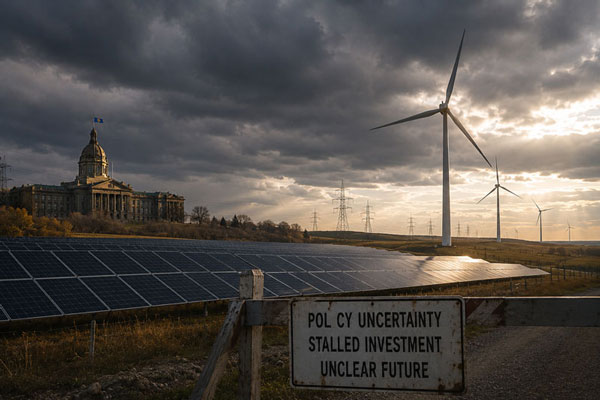
- Alberta’s renewable energy boom has stalled, with corporate clean-energy deals falling 99% from their 2023 peak.
- Developers still see demand, but policy uncertainty and a shrinking project pipeline are raising questions about when investment will return.
Alberta’s once-dominant renewable energy market has entered a sharp slowdown, with new corporate clean-energy deals falling 99% from their 2023 peak as developers and buyers wait for clarity on sweeping changes to the province’s electricity market.
The decline follows Alberta’s seven-month pause on approvals for large renewable projects beginning in August 2023 and a series of subsequent regulatory changes affecting land use, reclamation, transmission and electricity-market rules.
According to Business Renewables Centre Canada’s 2025 Renewables in Review, corporate renewable deals had already fallen 95% between 2023 and 2024. By 2025, dealmaking had “virtually disappeared.”
The development pipeline is thinning

Marlaina Danielle Smith ECA is a Canadian politician and journalist who has been serving as the 19th premier of Alberta since October 11, 2022, and leader of the United Conservative Party since October 6, 2022. Smith entered provincial politics in 2009, becoming the leader of the Wildrose Party.
The slowdown is now showing up beyond contracts.
Alberta recorded no new wind capacity additions in 2025, the first such year since 2018, while solar added just 38 MW, its weakest annual increase since 2019, according to the report.
More than 800 MW of construction-ready solar projects and over 300 MW of construction-ready wind projects cancelled their grid connection requests during 2025. By year-end, just 146 MW of construction-ready wind remained in the pipeline.
That matters because corporate power purchase agreements, or PPAs, helped finance much of Alberta’s previous renewable buildout. More than 60% of renewable projects in the province have been supported by PPAs, the report estimates.
Those projects helped generate more than $7 billion in capital investment and roughly 7,000 construction jobs. In 2025 alone, PPA-backed projects contributed more than $30 million in municipal taxes.
Alberta says reforms are about reliability
The provincial government argues its reforms are intended to create a more reliable and affordable electricity system, not discourage renewable investment.
Alberta is restructuring its electricity market and transmission framework, with a new market structure targeted for implementation in 2027. The government says the changes are necessary as electricity demand grows and the grid becomes more complex.
New environmental rules are also taking effect. A provincial code governing solar and wind reclamation became effective in June 2025, with updated application procedures introduced in April 2026.
Meanwhile, Alberta is pursuing new electricity pathways for large loads such as data centres, including frameworks that could allow facilities to bring their own generation.
Demand has not disappeared

The parliamentary system in Alberta has three branches: the legislative, which makes the laws; the executive, which puts laws into force and administers legislation; and the judicial, which applies and interprets laws through the courts.
The striking part of Alberta’s downturn is that it does not appear to reflect a collapse in corporate appetite for renewable power.
BRC-Canada estimates Canada’s 100 largest companies will require approximately 7.7 GW of renewable capacity over the next 15 years to meet existing climate commitments.
Other provinces are beginning to compete for that investment. Nova Scotia added 262 MW of wind through its Green Choice Program, becoming only the second province represented in BRC-Canada’s corporate deal tracker.
For Alberta, the next phase will therefore be less about proving demand exists and more about restoring confidence.
The province still has strong renewable resources, experienced developers and an electricity market capable of attracting private capital. But long-term energy projects depend on predictable rules. Alberta’s challenge is ensuring its reforms deliver enough certainty for investors to start signing long-term contracts again.









Comments