



 By
By 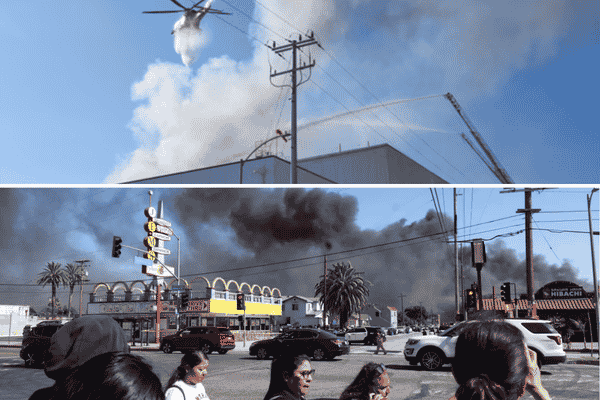
- A nearly 500,000-square-foot cold storage warehouse in Boyle Heights caught fire, sending thick black smoke across Los Angeles.
- An ammonia leak forced authorities to issue shelter-in-place orders and prompted extensive air quality monitoring.
- Firefighters used helicopters to battle the rooftop blaze, highlighting the growing challenges of fires involving solar infrastructure and potential battery storage systems.
Thousands of residents in Los Angeles were ordered to shelter indoors Wednesday after a massive fire erupted at a cold storage warehouse in the Boyle Heights industrial district, sending thick black smoke across the city skyline and raising concerns about toxic ammonia exposure.
The fire broke out shortly after 2:30 p.m. at a nearly 500,000-square-foot cold storage facility operated by Lineage, one of North America’s largest temperature-controlled logistics companies. The warehouse, located just east of downtown Los Angeles, serves businesses connected to the Ports of Los Angeles and Long Beach.
By the time firefighters arrived, flames had spread across the building’s roof, which was covered with solar panels. More than 100 firefighters responded to the incident, initially attacking the blaze from both inside the structure and on the roof.
Ammonia Leak
The response changed dramatically when a pressurized ammonia line was compromised inside the facility.
Ammonia is widely used as a refrigerant in industrial cold storage operations because of its efficiency and low cost. However, it is also toxic and potentially flammable. The leak prompted authorities to issue shelter-in-place orders covering a large portion of Boyle Heights while air quality officials monitored conditions downwind of the fire.
Residents were instructed to remain indoors, close windows and doors, and turn off ventilation systems. Officials later lifted the shelter-in-place order Wednesday evening after determining that conditions had improved.
The South Coast Air Quality Management District nevertheless maintained a smoke advisory for portions of East Los Angeles and the San Gabriel Valley through Thursday morning.
Unusual Firefighting
As flames spread across the expansive rooftop, firefighters were forced to retreat because of safety concerns related to the ammonia release and structural risks.
In a rare move, Los Angeles Fire Department helicopters began conducting aerial water drops on the building. Fire Chief Jaime Moore said such tactics are typically reserved for wildfires and are seldom used on commercial structures.
Officials also expressed concern that the solar-equipped facility could contain lithium-ion battery storage systems, which present additional challenges because of the risk of thermal runaway, a chain reaction capable of reigniting fires and producing hazardous smoke.
Pattern of Incidents
The Boyle Heights facility is no stranger to fire.
A smaller rooftop solar fire occurred at the same warehouse in 2024. Elsewhere, Lineage has faced regulatory scrutiny, including a 2023 Environmental Protection Agency settlement related to ammonia safety management at an Iowa facility.
The incident follows several major warehouse fires across California in recent months, including large-scale blazes in Ontario and Tracy that destroyed more than two million square feet of warehouse space combined.
Perspective
While investigators continue to determine the cause of the fire, the incident highlights the growing complexity of modern industrial facilities. Warehouses increasingly combine refrigeration systems, rooftop solar arrays, and potentially battery storage technologies in a single location.
These technologies offer significant economic and environmental benefits, but they also create new challenges for emergency responders.
As solar and energy storage become more common across industrial properties, fire departments and regulators may face increasing pressure to update safety standards, emergency response protocols, and facility design requirements to keep pace with a rapidly evolving energy landscape.








Comments