



 By
By 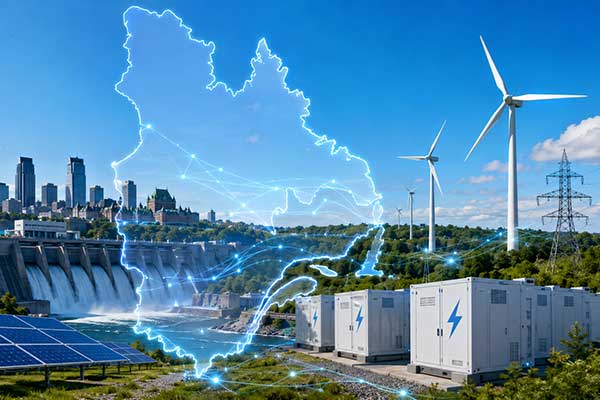
- Quebec aims for 77% of all energy consumed to come from renewable sources by 2050, up from 48% today.
- The plan includes up to 25 GW of wind, 5 GW of solar, expanded hydroelectric generation and greater use of energy storage.
- Achieving the targets is expected to require approximately $87 billion in additional investments over the next 25 years.
MONTREAL — The Quebec government has released its first-ever integrated energy resource management plan (PGIRE), outlining a long-term roadmap that would see renewable energy supply the majority of the province’s energy needs by 2050.
The strategy sets a target for 77% of Quebec’s total energy consumption to come from renewable sources by mid-century, compared with approximately 48% today. If achieved, the province’s dependence on fossil fuels would decline from roughly 52% to 23%.
Energy Minister Bernard Drainville announced the plan Tuesday in Varennes, describing the transition as ambitious but necessary to meet rising electricity demand while supporting economic development and reducing greenhouse gas emissions.
Delivering the plan will require an estimated $87 billion in investments over the next 25 years. The funding will support upgrades to existing hydroelectric facilities alongside significant expansion of wind, solar, bioenergy and electricity infrastructure.

Energy Minister Bernard Drainville unveiled on Tuesday the province’s 25-year resource management plan. (Sylvain Roy Roussel/Radio-Canada)
Government officials said only a small portion of that investment overlaps with Hydro-Québec’s previously announced $200-billion capital program through 2035.
Among the plan’s most significant targets are up to 25 GW of installed wind capacity and up to 5 GW of solar generation by 2050. Today, Quebec has approximately 4.2 GW of wind and only about 20 MW of solar, highlighting the scale of expansion envisioned.
The plan also recognizes energy storage as an increasingly important part of the province’s future electricity system, helping integrate larger volumes of renewable generation while improving reliability and flexibility during periods of peak demand.
The Canadian Renewable Energy Association (CanREA) welcomed the announcement, saying the plan places wind, solar and energy storage at the centre of Quebec’s electricity future.
“Quebec’s PGIRE places wind and solar at the heart of the province’s electricity future and recognizes the important role of energy storage,” said CanREA President and CEO Vittoria Bellissimo. She added that achieving the province’s ambitions will require predictable procurement programs, regulatory certainty and expanded transmission infrastructure.
Jean Habel, CanREA’s Senior Director of Policy for Quebec and Atlantic Canada, said the strategy positions renewable energy as a long-term economic driver capable of creating jobs while supporting municipalities, Indigenous communities and industrial growth.
The release of the PGIRE comes as electricity demand across Canada continues to rise due to the electrification of transportation, buildings and industry. By providing a long-term roadmap for generation, transmission and storage, Quebec joins a growing number of jurisdictions adopting integrated planning approaches to prepare for a cleaner and more electrified economy.
Why This Matters
Quebec has long relied on hydroelectricity, but the province is now formally recognizing that hydro alone will not meet future electricity demand.
The inclusion of 25 GW of wind, 5 GW of solar, and expanded energy storage represents one of the strongest policy signals yet that renewable technologies will play a central role in Quebec’s next phase of grid expansion.
For developers, manufacturers, utilities and investors, the plan provides greater visibility into the province’s long-term procurement direction and creates significant opportunities across the clean energy supply chain.










Comments