



 By
By 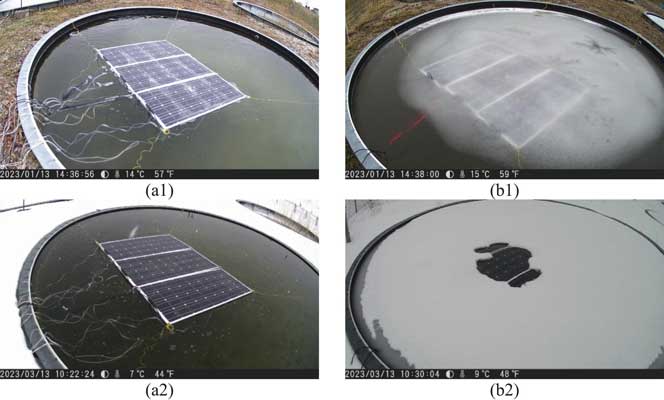
- A foam-backed floating photovoltaic system with an air-bubbler beneath the panels operated year-round on an Ontario pond, remaining ice-free through winter with auxiliary energy use of only 0.02–14.5% of annual PV yield.
- The 7 kW system produced 7.7 MWh, about 2.7% more than a reference FPV, and reduced water evaporation, indicating technical feasibility of FPV in icy climates.
To accommodate the increasing demand for clean energy, researchers have been developing floating solar panels for rivers, reservoirs and other waterways in recent years.
While there is, of course, plenty of land for solar farms, problems arise when these projects clash with farming and nature conservation.
In new research published in the journal Applied Energy, scientists demonstrate how one type of floating solar system operated during Canada’s cold winter conditions and efficiently generated clean energy.
Ice problem
One of the things holding back deployment of solar panels in cold environments is the concern that freezing temperatures will cause thick ice to form on the water, which computer models suggest could damage or stress a floating structure.
To prevent this from happening, researchers at Canada’s Western University built a foam-backed floating photovoltaic (FPV) panel with a novel air-bubbler system.
To test this design, they built a 7-kilowatt system and deployed it on a stormwater pond in Ontario.
Instead of using bulky plastic rafts that typically support floating solar panels in warmer climates, the team attached flexible solar panels directly onto sheets of thick, waterproof foam. The benefit is that the panels are less exposed to wind, which can affect traditional tilted systems.
The ice problem was tackled by installing air lines directly beneath the floating panels, with a pump on the shore pushing a steady stream of bubbles through them from the bottom of the pond. Because water is slightly warmer at the bottom during winter, rising bubbles push that warmth upward toward the panels.
A year of testing
The team monitored their floating system, which covered about 3% of the pond, continuously for a year. They report that they kept the panels ice-free throughout winter using only a tiny amount of additional energy. “The deployed air-bubbler system successfully maintained ice-free open water throughout the winter season with negligible additional energy consumption, ranging from 0.02% to 14.5% of the total annual yield,” the authors wrote in their paper.
The system generated 7.7 megawatt-hours of electricity, which was around 2.7% more productive than a reference floating system used in the study.
By shading the water, the panels also reduced evaporation. If they covered half the pond, the team estimated they could save roughly 927 cubic meters of water annually.
“Overall, the results of this study established foam-based FPV as a promising and adaptable platform for renewable energy generation … and highlights the unique performance dynamics of flat-tilt FPV modules in icy environments,” said the researchers.
Next, the researchers would like to test their technology at a larger scale and on diverse bodies of water.
Publication Referenced in the Article:
Koami Soulemane Hayibo et al, Design and thermal-energy performance analysis of foam-based floating photovoltaic systems in a cold climate: experimental results from a 7 kW floatovoltaics in Canada, Applied Energy (2026). DOI: 10.1016/j.apenergy.2026.128159
This article has been adapted from source material published by Canada’s Western University.





Comments