



 By
By 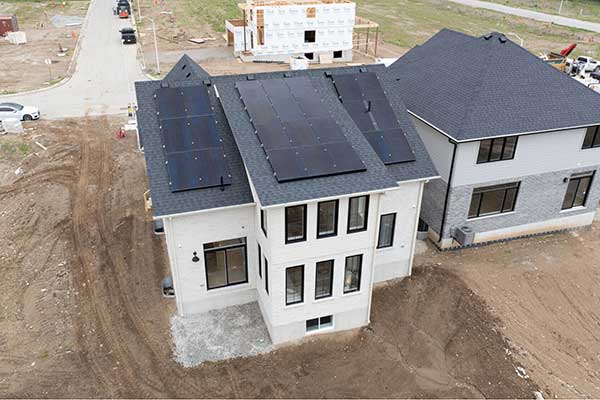
- A fully electrified home integrating photovoltaics, a heat pump, and a thermal battery achieves a 45% reduction in electricity bills and a 55% decrease in carbon emissions compared to conventional systems.
- The thermal battery, using phase-change materials, boosts solar self-consumption by 60%.
- This approach demonstrates high energy efficiency, scalability, and potential for retrofitting existing homes.
Western engineers have amalgamated the function and force of photovoltaics (PV) technology with a heat pump and a thermal battery to create a fully electrified—and energy efficient—new house. The end game is to eliminate the need for fossil fuels, achieving real net-zero energy consumption for homebuilders and homeowners around the world.
Western Engineering and Ivey Business School professor Joshua Pearce and Ph.D. candidate Shafquat Rana, in collaboration with mechanical and materials engineering chair Anthony Straatman, engineering professor Kamran Siddiqui and Magnus Homes’ president Jaime Crncich, have designed and developed this first-of-its-kind energy-efficient home system. A two-story home in Komoka, Ont. (just west of London, Ont.), serves as a living lab for observational experimentation and data generation.
Preliminary results show this setup, unique in Canada, reduces electricity bills by 45%, and carbon emissions for the home by 55%. The thermal battery, which uses a phase-change material like salt or wax, stores energy efficiently, increasing solar PV self-consumption (using energy that is produced on site, rather than exporting it to the grid) by 60%. A phase change material is a substance that absorbs or releases large amounts of thermal energy during melting or freezing to maintain a stable temperature.
“Solar costs have now undercut grid electricity costs, making solar a viable and desired option for most Canadians,” said Pearce, Western’s John M. Thompson Chair in Innovation. “This project integrates solar panels, a heat pump and a thermal battery to provide thermal energy for heating and supplying domestic hot water demand to the entire home.”
The researchers developed best practices to make a house four times more energy efficient than traditional methods by using a heat pump, which converts the sunlight-generated electricity captured by the solar panels atop the house into heat. This heat is stored in a thermal battery for future use. The researchers aim to show the technology is entirely scalable, safe and importantly, can be retrofitted into existing homes with minimal modifications.
“The goal is to prove the system’s effectiveness over one year, with the ultimate aim of eliminating the need for fossil fuels in home heating altogether,” said Rana, an electrical engineering student. “Once validated, we want to expand this system to other homes across Canada, and eventually around the world.”
Rana outfitted the new house with wiring and sensors to track and predict energy usage, efficiency and cost savings—data both she and Crncich, the homebuilder who also lives in the house being studied, can monitor in real-time on their mobile devices and personal computers with a user-friendly app.
“We have a unique opportunity to both create and consume the energy in our homes and it’s really interesting to see, both as an owner and a builder, how those two balance,” said Crncich. “I think a lot of homeowners aren’t aware of their consumption and that’s really important for sustainability, knowing the role you’re playing in the consumption and production of energy for your home.”
For even more data, Rana is monitoring a second home built by Crncich (similar in model and located in the same Komoka subdivision) that was not outfitted with the integrated thermal battery and solar PV system, to compare the fully electrified home with a traditional Canadian house using grid electricity and natural gas supply.
‘Electrifying’ our homes
While heat pumps and thermal batteries are quite common in the U.S., regulatory approvals for both systems are relatively new in Canada. This exacerbates the energy problem, as it is very expensive to heat a home north of the border.
“Many homes in Canada, unfortunately, are not even up to current code, let alone equipped with state-of-the-art photovoltaic technology,” said Pearce. “Secondly, most people heat their homes with either natural gas or electric space heating, which is incredibly inefficient and hurts financially, as Ontario is seeing electricity prices skyrocket again and again. Similarly, natural gas prices fluctuate, but solar provides a hedge against energy inflation.”
Pearce says electrifying homes is a key pathway to long-term sustainability in Canada and around the world.
“If we can use renewable energy sources like solar power to provide electricity for our homes and then transfer that energy to a heat pump, for every one unit of electric energy, we get three units of heat, making them 300 percent efficient or more,” said Pearce. “It’s simply a far more efficient way to heat your home.”
Rana says this novel approach to energy production and consumption goes far beyond providing comfort—and a lower electricity bill—for homeowners. It’s about saving the planet. Rana showed in a recent study that Canada was not growing renewable energy fast enough to meet climate commitments.
“Climate change is real, and we need everyone on the planet to put even a small effort towards the fight,” said Rana. “Decarbonization of the residential sector is low-hanging fruit, which everyone can see. The integration of this sustainable setup in Canadian homes, especially new ones, can help us greatly reduce Canada’s carbon emissions to address the global impact of climate change.”
The team’s related research has been published in the journals Energies, Energy and Buildings and e-Prime – Advances in Electrical Engineering, Electronics and Energy.
Publication Referenced in the Article:
Shafquat Rana et al, A Review of Phase-Change Material-Based Thermal Batteries for Sustainable Energy Storage of Solar Photovoltaic Systems Coupled to Heat Pumps in the Building Sector, Energies (2025). DOI: 10.3390/en18133265
This article has been adapted from source material published by the University of Western Ontario.






Comments