



 By
By 
- Alberta projects three years of significant deficits driven largely by falling non-renewable resource revenues and rising public service costs.
- The budget promotes electricity growth and clean energy investment but offers no major new capital funding or incentives for renewables.
- Solar’s future in Alberta will depend more on electricity market reforms and investor confidence than on direct government subsidies.
Alberta’s 2026 budget reads like a province caught between two realities.
On one side, record oil production and a government still intent on positioning Alberta as a global energy supplier. On the other hand, weakening oil prices, slowing population growth, and three consecutive years of projected deficits underscore how exposed the fiscal framework remains to commodity cycles.
For renewables, and solar in particular, the budget sends a nuanced signal: growth is expected, but not publicly underwritten.
Deficit Framed by Oil
If passed, Budget 2026 projects deficits of $9.4 billion in 2026–27, followed by $7.6 billion and $6.9 billion in subsequent years.
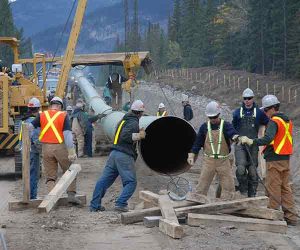
The Kinder Morgan Trans Mountain Pipeline System, or simply the Trans Mountain Pipeline, is a pipeline that carries crude and refined oil from Alberta to the west coast of British Columbia, Canada.
Total revenue in 2026–27 is forecast at $74.6 billion, down from the prior forecast largely because of a $3.1 billion drop in non-renewable resource revenue. Bitumen royalties remain central to the revenue mix, and raw bitumen production is forecast to continue rising.
The government’s oil price assumption — US$60.50 per barrel in 2026–27- reflects caution, but also highlights vulnerability. Even at record output levels, declining prices widen the deficit. Taxpayer-supported debt is projected to rise sharply, and debt servicing costs will climb.
This fiscal backdrop matters for renewables. With a total expense forecast of $83.9 billion in 2026–27 and spending concentrated in health care ($34.4 billion) and education ($10.8 billion), there is limited fiscal room for new clean energy subsidies. The three-year $28.3 billion capital plan prioritizes schools, hospitals, roads and bridges. Renewable energy infrastructure is not singled out for a dedicated capital envelope.
Solar in a Restructured Market
Yet the budget does not sideline renewables. It explicitly forecasts stronger growth in 2027 as investments in electricity generation and clean energy gain momentum. Alberta’s electricity demand is projected to double by 2050, implying substantial additions to capacity.
Within the utilities portfolio, the Renewable Electricity Program is forecast to decline by $14 million in 2026–27, reflecting higher power prices and lower required payments to operators. In effect, the province is signaling that renewables must increasingly stand on market economics rather than government top-ups.
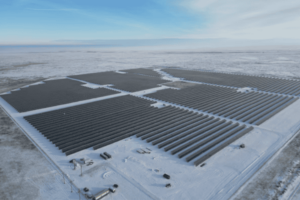
The Tilley Solar project consists of 70,000 photovoltaic panels. At its peak, the site will generate 280 full-time jobs and $20-million in labour income. (Tilley Solar Alberta/Supplied via The Globe And Mail)
The government is also advancing a Restructured Energy Market and exploring nuclear development as a firm baseload complement to intermittent renewables. Solar’s role, therefore, is framed as complementary — scalable, cost-competitive and responsive to demand growth — but not the backbone of grid reliability.
For developers, this hybrid strategy creates opportunity. Alberta remains one of Canada’s most market-driven electricity systems, where merchant solar projects can capture price volatility. But it also introduces risk: regulatory design will determine whether new solar capacity is rewarded or squeezed in a rebalanced market.
Diversification Without Direct Subsidy
The government has spoken about industrial diversification, and the budget echoes that ambition by promoting alternative energy and environmental technology industries. At the same time, it reinvests in the Heritage Fund, aiming for long-term financial security rather than short-term program expansion.
The deeper message is pragmatic. Alberta’s government is not abandoning renewables, but it is not repositioning the province as a clean energy state through fiscal activism. Solar’s future will depend less on direct public spending and more on investor confidence, market design and clarity around federal-provincial carbon policy alignment.
As global clean energy investment now outpaces fossil fuels, Alberta’s wager appears to be that solar can thrive on economics alone. Whether that bet pays off will hinge on the stability of the electricity market reforms now underway — and on how long oil revenues can continue to shoulder the province’s fiscal load.










Comments