


 By
By 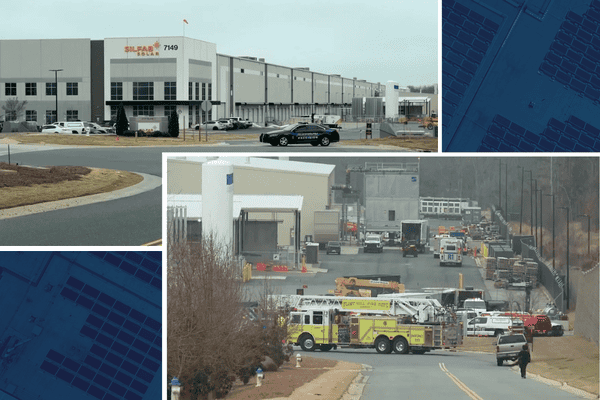
- Silfab Solar disputes reports of major chemical spills, saying the incidents involved limited releases that posed no risk to workers or the public.
- State and federal regulators investigated the events and allowed the plant to resume limited assembly operations while manufacturing remains paused.
- Community opposition has intensified, with parents and activists questioning the safety of an industrial solar facility located near an elementary school.
Silfab Solar is pushing back against reports of significant chemical spills at its Fort Mill, South Carolina facility, even as regulators continue to review the incidents and local opposition intensifies.
The controversy follows an earlier report by PV Tech, which detailed two chemical-related events at the plant last week involving potassium hydroxide and hydrofluoric acid, substances commonly used in solar cell manufacturing. The incidents prompted an investigation by the South Carolina Department of Environmental Services (SCDES) and the U.S. Environmental Protection Agency (EPA), while a nearby elementary school temporarily closed as a precaution.
In response, Silfab executives say the situation has been exaggerated.
Greg Basden, the company’s director of operations, said the first event involved roughly 300 gallons of water containing small amounts of potassium hydroxide, a caustic chemical used to clean silicon wafers during solar cell production. Initial reports cited a potential spill exceeding 1,500 gallons, but Basden said that estimate reflected a worst-case early report later revised downward.
“At no time during this event were any employees or the public put at risk,” Basden said in remarks to reporters.
Silfab Solar is a Canadian-based manufacturer of PV modules.
The second incident involved a small release of hydrofluoric acid from a storage tank. Basden described it as a minor drip that engineers reduced to roughly one drop per hour after identifying the source. The company says it reported both events to authorities in accordance with state and federal protocols.
Despite those assurances, regulators intervened. State and federal officials conducted a site inspection this week and allowed Silfab to resume limited assembly operations, though full manufacturing remains suspended while investigations continue. Manufacturing processes that use potassium hydroxide and hydrofluoric acid cannot begin until the company hires an engineer to evaluate chemical systems and improve leak detection procedures.
The facility’s proximity to Flint Hill Elementary School, located only a few hundred feet away, has amplified public concern. Fort Mill School District closed the school for two days after the incidents, and some parents kept children home even after classes resumed.
Community activists remain skeptical. Brandon Dunford of Move Silfab, a local group opposing the plant, called the decision to allow partial operations “bad news,” arguing the facility should be relocated farther from residential areas and schools.
Parents have also begun pushing local officials for stronger oversight. Some are urging York County Council to revoke Silfab’s certificate of occupancy, while state lawmakers have introduced legislation that would tighten zoning and permitting rules for industrial projects located near schools.
The Fort Mill facility is part of a broader expansion of domestic solar manufacturing across the United States. Companies like Silfab are building factories in response to federal incentives under the Inflation Reduction Act, which aims to reduce reliance on imported solar panels and strengthen domestic supply chains.
But the Fort Mill episode illustrates the challenges that can accompany that expansion. Solar manufacturing, much like semiconductor fabrication, relies on industrial chemicals that require strict safety controls. When facilities are located close to communities, particularly schools, transparency and trust can become as important as regulatory compliance.
For now, Silfab maintains that the incidents posed no public danger and that operations will proceed safely. Yet the growing scrutiny suggests that the future of the plant may depend less on the technical details of the spill reports than on whether the company can convince a wary community that it belongs there at all.






Comments