



 By
By 
- The Ford government’s fall economic statement quietly repeals sections of the 2018 Cap and Trade Cancellation Act that required emissions targets and public progress reports.
- The move follows an auditor general’s report showing Ontario is on track to miss its 2030 climate goals by a growing margin.
- The repeal could undermine a youth-led constitutional climate case and signals a broader retreat from measurable, transparent environmental policy.
Ontario’s latest move to strip away its legal obligations to set and report on greenhouse gas emissions targets is more than an administrative adjustment. It’s a retreat from accountability, one that threatens to widen the gap between political rhetoric and the province’s actual contribution to the climate fight.
The decision, quietly embedded in last week’s fall economic statement, repeals key sections of the 2018 Cap and Trade Cancellation Act. These sections required the government to set clear emission-reduction targets, maintain a climate plan, and release public progress reports.
In doing so, Premier Doug Ford’s government is removing one of the few remaining mechanisms that allowed Ontarians to measure whether the province is living up to its climate promises.
Finance Minister Peter Bethlenfalvy defended the change by saying the government will “focus on outcomes, not targets.” But outcomes require measurement, and measurement requires targets. Without them, the province is essentially asking the public to take its word for it, an act of faith that recent evidence makes difficult to grant.
Pattern of Retreat
The timing is telling.
Ontario’s auditor general recently concluded the province is on track to miss its 2030 emission-reduction goal by an even wider margin than previously reported. The environment ministry hasn’t issued a new climate progress report since 2021, and its 2022 update simply recycled old data.
Meanwhile, a youth-led constitutional lawsuit, arguing the province’s watered-down climate plan violates Charter-protected rights, is scheduled for hearings next month. By scrapping the sections of law central to that case, the government risks appearing less interested in defending its policy than in erasing the very framework under which it might be judged.
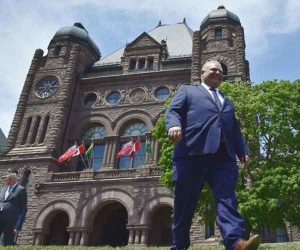
Premier Doug Ford on the lawn of the Ontario legislature on Friday, June 8, 2018. (THE CANADIAN PRESS)
This isn’t the first time Ontario has dismantled its own climate infrastructure.
The Ford government’s first act in 2018 was to scrap the province’s cap-and-trade program, severing Ontario’s link to California and Quebec’s carbon market. It also replaced the former Liberal government’s emissions target, 37 percent below 1990 levels by 2030, with a weaker goal: 30 percent below 2005 levels.
At every turn, accountability mechanisms have been stripped away, while promises of “balance” and “practicality” have taken their place.
Cost of Opacity
Ontario’s shift from targets to “outcomes” is part of a troubling trend. Governments increasingly prefer aspirational language, resilience, transition, affordability, over the hard numbers that make progress measurable.
Yet investors, businesses, and citizens need data they can verify. Without a transparent framework, Ontario risks undermining confidence in its long-term energy and industrial strategies, just as federal and international partners are tightening their own climate disclosure rules.
It also sends a dangerous signal to other provinces: that the easiest way to avoid criticism or litigation over climate performance is to simply erase the benchmarks. Such reasoning may spare short-term political discomfort, but it weakens the foundation for evidence-based policymaking in an area where transparency is already scarce.
Leadership Test
Ontario once led the country in climate action, eliminating coal-fired power plants and helping drive down national emissions. Today, it stands on the defensive—recasting climate accountability as a bureaucratic nuisance rather than a governing responsibility.
If the Ford government truly believes in “outcomes,” it should define them clearly, publish data to verify them, and invite public scrutiny of its progress. Otherwise, this repeal will be remembered not as a modernization of climate policy, but as a deliberate unmooring of the province from the standards it once helped set.
Ontario’s economic and environmental futures are intertwined. Transparency is not an obstacle to progress; it is the condition for public trust.
In choosing secrecy over scrutiny, the province is betting that voters, and investors, won’t notice. History suggests they will.






Comments