



 By
By 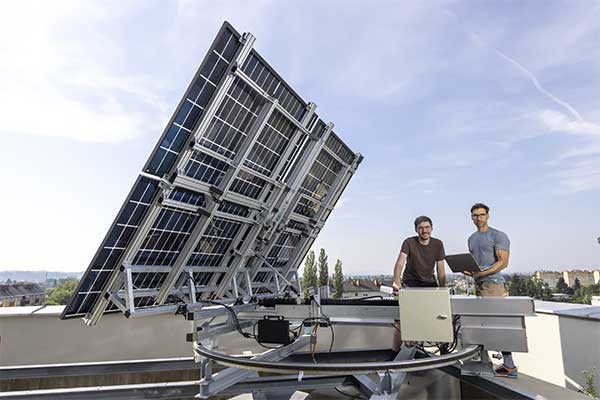
- A dual-function, sun-tracking PV system (FLAPTrack) uses a patented linear actuator to both track solar position and fold modules into a protective stow position.
- Optimal two-axis tracking increases annual yield by ~40% versus fixed systems, with up to 56% on some days and >2× output at off-peak times, while folding mitigates wind, hail, and snow loads, improving winter performance and system reliability.
Researchers led by Armin Buchroithner from the Institute of Electrical Measurement and Sensor Systems at TU Graz have developed an innovative photovoltaic system that combines significantly higher output with protection from storms, hail and snow.
The system, known as FLAPTrack (Face-to-Face Lay-Down Anti-Degradation Protection), continuously aligns the PV modules with the sun’s position both horizontally and vertically.
At night and when a storm is approaching, the modules fold up automatically, protecting them from damage and possible shading caused by snow and dust. A demonstration system with a capacity of 1.8 kWp is currently operating on the roof of an office building on the Campus Inffeldgasse of Graz University of Technology (TU Graz).
The work is published in the journal Renewable and Sustainable Energy Reviews.
Patented folding mechanism
“The system’s key innovation is a patented linear actuator that fulfills two functions: It tracks the sun and folds the panels to a protective stow position,” explains Buchroithner. “This dual function enables us to save on installation and operating costs, thereby improving cost-effectiveness.”
Grid load reduction and up to 56% additional yield
Due to its optimal alignment with the sun—horizontal rotation is achieved via a belt drive in a circular guide close to the ground—FLAPTrack delivers an average increase in energy yield of just under 40% compared with fixed PV modules. On some days, the increase was as high as 56%.
“However, the key to the system’s cost-effectiveness is the additional electricity yield during off-peak hours. In the mornings and evenings, when general electricity consumption is particularly high, FLAPTrack delivers more than twice as much electricity as traditional PV systems due to its optimal tracking of the sun’s position, which also helps mitigate grid loads and avoid instabilities,” says Buchroithner.
This effect is particularly pronounced during the winter months and in locations at higher latitudes due to the sun’s lower position in the sky. Furthermore, the folding mechanism keeps the PV modules free of snow, which often drastically reduces the efficiency of conventional PV systems in winter.
Protection against gusts of wind and hail damage
The folding mechanism reduces the surface area exposed to gusts of wind and provides protection against hail—both of which are serious threats to solar power systems and are likely to become more common as a result of climate change.
“Damage to silicon wafers caused by hailstones can lead to hotspots, which reduce the efficiency of the entire module due to their increased internal resistance,” says Buchroithner. There is no such risk with FLAPTrack.
The system, which is linked to a local weather station and regional weather forecast models, folds the PV modules up face-to-face and lays them flat on the ground in the event of a storm or hail. The back sides of the modules can be protected from impact by using an inexpensive hail net.
For a long-term test, the researchers have equipped the PV system with numerous sensors that collect data on the weather, energy yield, wear and tear, and the forces exerted by the wind. The data forms the basis for further optimizing autonomous operation and reducing weight through lightweight design.
Publication Referenced in the Article:
Armin Buchroithner et al, The future of PV tracking? An interdisciplinary performance assessment of a novel design with panel protection, Renewable and Sustainable Energy Reviews (2025). DOI: 10.1016/j.rser.2024.115287
This article has been adapted from source material published by Graz University of Technology.





Comments