



 By
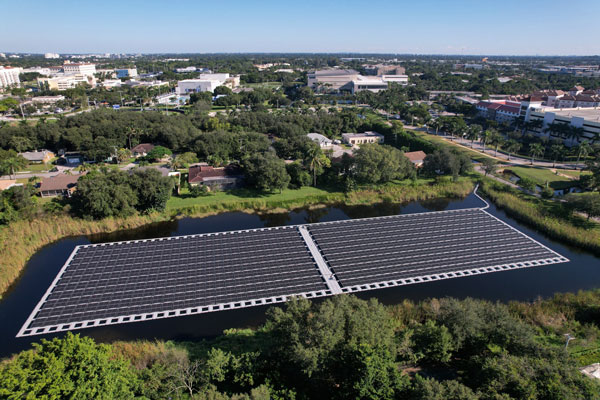
- Canadian municipalities could use existing stormwater ponds to generate renewable electricity for public facilities and local communities without requiring additional land.
- Floating solar costs have fallen approximately 48% since 2015, making the technology increasingly attractive for municipal renewable energy projects despite remaining more expensive than conventional solar.
- Western University researchers successfully operated a 7-kW floating solar installation on an Ontario stormwater pond year-round, generating 7.7 MWh of electricity while preventing winter ice formation.
Across Canadian cities, thousands of stormwater management ponds collect runoff from roads, neighbourhoods and commercial developments. These engineered water bodies serve an essential drainage function, but could also offer municipalities an opportunity to generate renewable electricity.
Florida is already demonstrating the concept.
The state has an estimated 76,000 stormwater ponds, some of which are being converted into floating solar installations. In November 2025, the Orlando Utilities Commission commissioned a 2-megawatt floating solar array featuring more than 3,400 panels.
For Canadian municipalities exploring community solar programs, the development offers a potential model for producing electricity closer to where residents consume it.
Turning municipal infrastructure into community energy assets
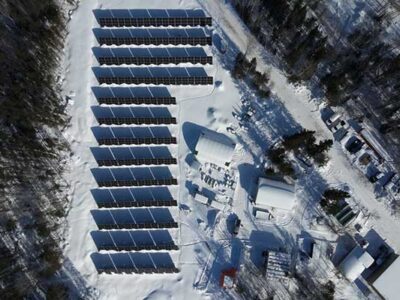
Floating photovoltaic systems, commonly called floatovoltaics, consist of solar panels mounted on buoyant platforms anchored to ponds, reservoirs and other water bodies.
Unlike conventional ground-mounted installations, they require little additional land, making them particularly attractive in urban environments where available space is limited.
The economics are also improving.
According to researchers cited in the Florida report, median floating solar installation costs declined approximately 48%, from $2.41 per watt in 2015 to $1.25 per watt in 2024.
Although floating systems remain roughly 10% to 25% more expensive than conventional land-based solar, declining costs could create opportunities for smaller municipal projects.
In Canada, municipalities could potentially develop installations on suitable stormwater ponds to power recreation centres, libraries, municipal buildings or nearby neighbourhoods.
Under appropriate provincial electricity regulations, these projects could also support community solar programs, allowing residents who cannot install rooftop panels to participate in locally generated renewable electricity.
Canadian research addresses the winter challenge
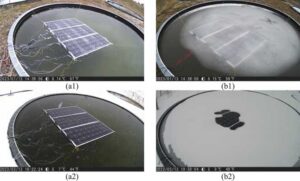
Impact of air bubbling on ice formation in foam-based FPV systems. The two images at the top represent the system with a bubbler (a1) and the system without a bubbler (b1) on a cold day with no snow. The two images at the bottom represent the system with a bubbler (a2) and the system without a bubbler (b2) on a cold day after a snowfall. Credit: Applied Energy (2026). DOI: 10.1016/j.apenergy.2026.128159
One significant obstacle to floating solar deployment in Canada has been uncertainty surrounding freezing temperatures and ice formation.
However, recent research from Western University in Ontario suggests these challenges may be manageable.
In a study published in Applied Energy, researchers tested a 7-kilowatt floating solar installation on an Ontario stormwater pond using flexible photovoltaic panels mounted on waterproof foam.
An innovative underwater air-bubbler system circulated relatively warmer water from the pond’s bottom toward the surface, preventing ice formation beneath the panels.
Over a year of monitoring, the installation generated approximately 7.7 megawatt-hours of electricity, outperforming a reference floating system by about 2.7%.
The researchers reported that the bubbling system successfully maintained ice-free conditions throughout winter, with auxiliary electricity consumption ranging from 0.02% to 14.5% of annual solar generation.
The findings provide encouraging evidence that floating solar could operate year-round in Canadian climates, although larger installations and different winter conditions require further testing.
A new opportunity for Canadian municipalities
Beyond winter performance, municipalities must consider water-level fluctuations, grid connections, maintenance requirements and ecological impacts.
Stormwater ponds support important water-quality functions and aquatic ecosystems. Excessive solar coverage could affect sunlight penetration, oxygen levels and biological processes.
Nevertheless, the opportunity warrants closer examination.
Rather than immediately pursuing large floating solar farms on natural lakes, Canadian municipalities could begin with controlled demonstration projects on existing engineered stormwater ponds.
These installations could establish real-world performance data, evaluate environmental impacts and test community solar business models.
For cities looking to expand local renewable energy generation without competing for increasingly valuable urban land, the next community solar project might already have a location: the neighbourhood stormwater pond.







Comments