



 By
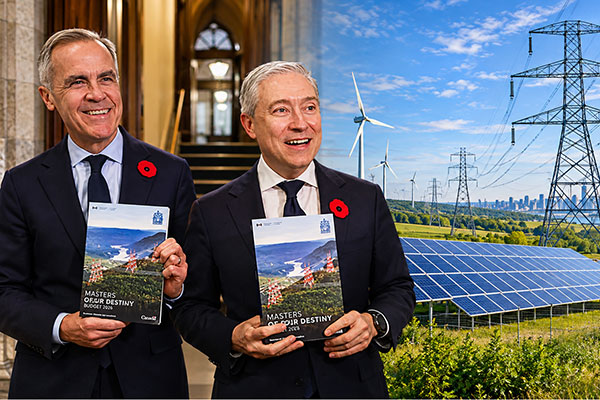
- Canada has committed $52 billion to expanding its electricity system, and the renewable energy industry is celebrating.
- But behind the ambitious numbers lies a much bigger challenge that money alone cannot solve.
- Whether Ottawa can overcome it could determine the future of solar, wind, and energy storage across the country.
Canada’s federal government has unveiled $52 billion in new electricity-related commitments as part of Budget 2026, signalling a major expansion of federal support for renewable energy, transmission infrastructure and grid modernization.
The measures, announced November 5, form part of Ottawa’s Powering Canada Strong strategy, which aims to double the country’s electricity system by 2050 while maintaining affordability and reliability.
Long-term incentives
A central measure extends the Clean Technology and Clean Electricity Investment Tax Credits through 2040, providing greater investment certainty for developers planning wind, solar and energy storage projects.
The 30% Clean Technology credit and 15% Clean Electricity credit will also be complemented by expanded eligibility for high-voltage transmission infrastructure within provinces, with the extensions and expansion projected to cost $38.5 billion.
The budget additionally commits approximately $4 billion toward electricity infrastructure, renewable energy development and grid modernization, including additional funding for the Smart Renewables and Electrification Pathways Program.
The Canadian Renewable Energy Association (CanREA) welcomed the measures, saying they reflect recommendations outlined in its Clean Power Nation report.
“This is a strong budget for affordable, reliable electricity,” said CanREA President and CEO Vittoria Bellissimo, emphasizing the importance of long-term policy certainty for attracting investment.
Growing electricity demand
Canada’s electricity requirements are expected to increase substantially as transportation, buildings and industrial operations electrify.

The sun sets behind Hydro wires in the Hamilton, Ont., steel mills area in a file photo from Nov. 23, 2018 (JournalPioneer).
The Canada Energy Regulator projects electricity demand will grow between 26% and 85% by 2050, depending on economic conditions, technology adoption and electrification policies.
Its modelling anticipates substantial additions of wind generation, alongside approximately 20–30 gigawatts of solar capacity and 15–23 gigawatts of battery storage by mid-century.
Meanwhile, Ottawa is proposing domestic-content incentives offering bonuses of up to 10 percentage points for qualifying Clean Technology investments and five points for Clean Electricity projects using Canadian-made components.
The incentives could strengthen domestic manufacturing, although their final design remains subject to consultation.
Industry welcomes investment, but execution remains critical
Electricity Canada described the budget as one of the country’s most significant electricity commitments in a generation.
However, industry enthusiasm comes with practical challenges, including lengthy permitting processes, equipment shortages, skilled-labour constraints and the difficulty of coordinating electricity infrastructure across provincial jurisdictions.
The federal government’s action plan acknowledges these barriers, identifying workforce development, transmission expansion and domestic manufacturing as priorities.
Perspective
Budget 2026 represents an important shift toward treating electricity infrastructure as a foundation of Canada’s economic competitiveness rather than solely an environmental investment.
Yet extending tax credits and announcing billions in support will accomplish little without faster approvals, coordinated provincial planning and projects reaching construction.
For Canada’s renewable energy industry, the opportunity is substantial, but the ultimate measure of success will be how quickly federal commitments translate into operating wind farms, solar installations, energy storage facilities and transmission infrastructure.










Comments